Two Weeks, One Loop: The Complete Cyclades Catamaran Circuit for 2027
The complete two-week Cyclades catamaran loop from Athens, with layover days built in to absorb the meltemi.
Read more
Updated May 2026.
Paros sits in the middle of the Cyclades — geographically central, ferry-connected to every direction, with one of the most varied charter coasts in the Aegean. A catamaran week around Paros mixes Cycladic-postcard villages, sheltered north-coast anchorages, windswept east-coast beaches (the famous wind-surfing kitesurfing meccas), and the short crossing to Antiparos and the uninhabited Despotiko. The meltemi shapes everything: where you anchor, when you sail, and which side of the island works on a given day. This guide is the working catamaran-charterer’s reference to the 11 Paros stops you should not miss, with anchorage detail and a 3-day route at the end. For the broader Greek picture, see our companion piece Greek Islands by Catamaran.
Parikia is the busy ferry hub on the west coast and the practical entry point to Paros. Charter boats can stern-to inside the small marina (€40-80 per night for a 45-foot cat) or anchor in the wider bay in 8-12 metres, exposed to westerlies. Worth a half-day for the Panagia Ekatontapiliani church (the “Church of 100 Doors”, 4th century — one of the oldest functioning Christian churches in Greece). Provision substantially here; Parikia’s supermarkets are the best on the island.
Naoussa is the marquee Paros stop and one of the prettiest single villages in the Cyclades. The small inner harbour is too tight for catamarans larger than 38 feet — most charter cats anchor in Naoussa Bay (8-12 metres on sand, well-sheltered by granite headlands) and tender into town. The whitewashed harbour-front with octopus drying on lines, the small Venetian fort at the entrance, the warren of streets behind the seafront — Cycladic aesthetic at its best. Top 10 reasons to visit Paros covers the wider Naoussa scene.
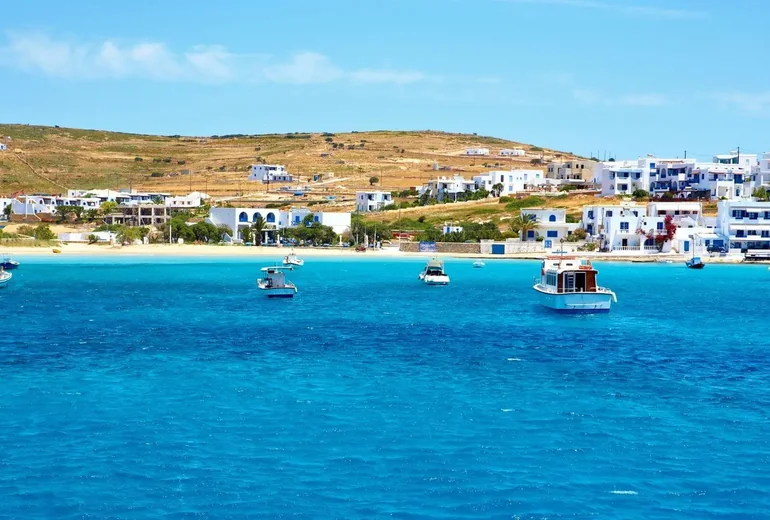
Two nautical miles southwest of Naoussa, on the western side of the same bay, Kolymbithres is the most-photographed beach on Paros. Wind-sculpted granite formations create a series of natural pools and sheltered swim coves. Anchorage: in 4-8 metres on sand bottom, just offshore from the main beach. Good holding, full shelter from the prevailing northerly. The granite formations themselves create natural breakwaters — the swim conditions stay calm even when the meltemi is building. Tender ashore to the small beach taverna (Tzanis) for lunch. Day stop or short overnight; the bay can fill with day-tripper boats from 11:00 onwards.
Monastiri Beach sits 1 NM east of Naoussa harbour, sheltered behind a granite headland in 5-9 metres on sand. Santa Maria, slightly further east, is the larger sandy bay favoured by Greek families, with a small water-sports centre and a beachfront taverna. Both work as alternatives to a crowded Naoussa overnight in mid-summer.
On the east coast, Kalogeros Beach is the unusual stop — terracotta clay cliffs that beach-goers crush and apply as a natural skin-pack. The bay anchors in 6-10 metres on sand-and-pebble, exposed to easterlies and northeasterlies (i.e. exposed to the meltemi). Day stop only; don’t overnight here in summer. If the wind drops or shifts west, it becomes one of the prettiest anchorages on the east coast.
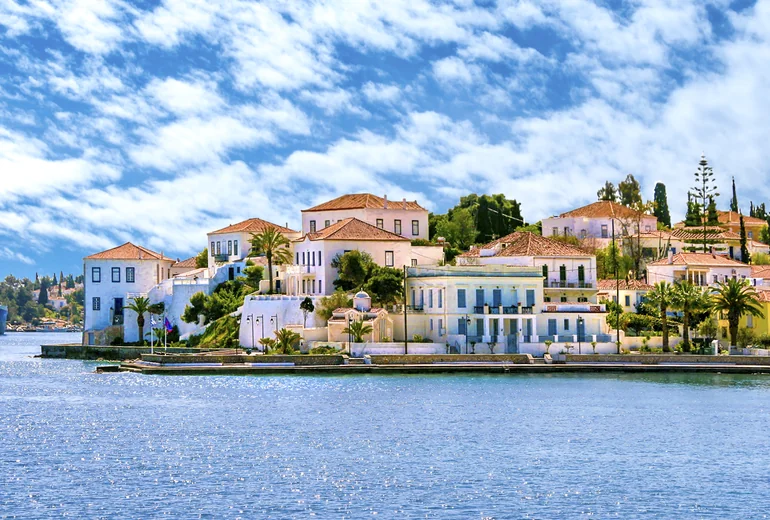
Pounta is the busiest east-coast Paros stop in summer — beach clubs, beach bars, and the small ferry-quay for the short hop to Antiparos. Anchorage: in 5-8 metres, exposed to the prevailing northerly. Day-stop only — most charters skip Pounta for sheltered north or south anchorages, but the beach-club scene (Tribali, Punda Beach Club) is worth a lunch visit.
Golden Beach and the smaller New Golden Beach (Mikri Chrysi Akti) sit on Paros’s east coast and are world-famous wind-surfing and kitesurfing destinations. The afternoon meltemi accelerates off the Paros mountain ridge and lands on Golden Beach reliably at 18-25 knots from June through September. Charter cats can anchor offshore in 5-9 metres on sand bottom and tender in for wind-sport rental at the established schools (Force 7, F2 Surf Center). Don’t overnight on the east coast in meltemi conditions; sail back to the north or south coast for the night. See weather conditions in the Cyclades for the full meltemi pattern.
Piso Livadi is the only sheltered east-coast harbour on Paros — small fishing port with a stone breakwater that handles charter boats stern-to (€30-60 per night) or anchored outside in 8-12 metres. Quieter than Naoussa, three reliable tavernas on the seafront. Useful overnight if you’ve spent the day on the east coast and don’t want to round the island in the late-afternoon meltemi.
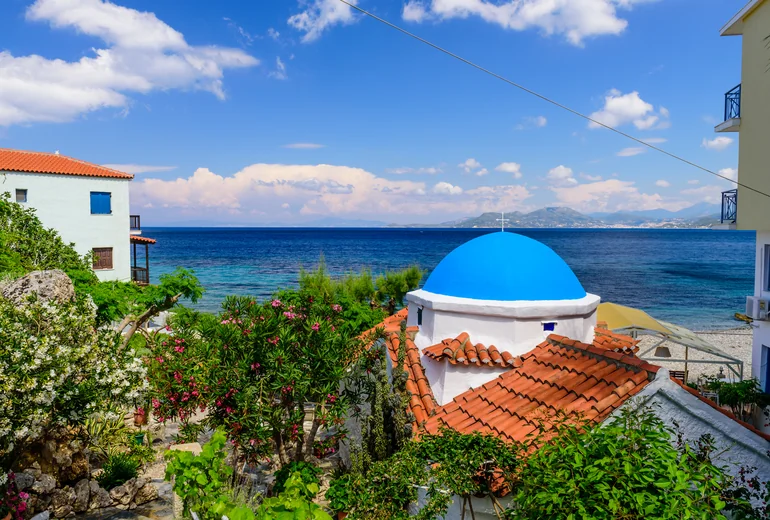
Aliki sits on Paros’s south coast and is the meltemi-day refuge for any charter cat caught in heavy northerlies. The bay is fully sheltered from the prevailing wind, anchors in 4-8 metres on sand bottom, and has a small village with three tavernas. Most catamaran charters end up here at least once during a Paros week — the day the wind builds past 30 knots on the north and east coasts. Don’t miss the small archaeological site at Aliki (Hellenistic temple ruins) and the longer walk to Kasos beach.
The Antiparos channel between Paros and Antiparos is 1 nautical mile wide at its narrowest — the shortest inter-island crossing in the Cyclades. Antiparos town (Chora) sits on the northwestern coast of the smaller island. Anchor in the main bay in 6-10 metres on sand-and-weed, or take a berth at the small Antiparos marina (limited capacity, €40-80 per night). The town is smaller and quieter than Naoussa, with the same Cycladic aesthetic. Worth one overnight; the post-dinner walk through the kastro at the centre of the town is the highlight.
The Cave of Antiparos sits on the southeastern slope of Antiparos’s main mountain, accessible by tender to Agios Georgios then a short taxi uphill, followed by 411 steps down. Entry fee: €5-7 per person in 2026. The stalactite formations are the largest in the Cyclades.
Despotiko is the small uninhabited island 1 NM southwest of Antiparos. Active excavations on the eastern side have uncovered a 6th-century BC Apollo sanctuary; the dig is open to visitors in summer (free entry, daylight hours). Anchorage: on Despotiko’s east side in 6-10 metres on sand, fully sheltered from northerlies. One of the quietest overnights in the Cyclades — no village, no light pollution.
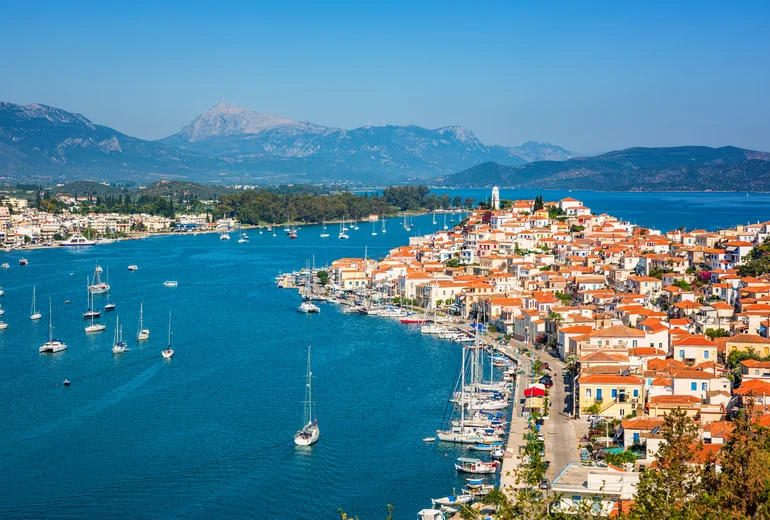
Most catamaran charterers reach Paros as part of a longer Cyclades week from Mykonos, Athens, or Naxos. The standard 3-day Paros stretch:
Day 1: arrive at Naoussa Bay from the north (Mykonos or Naxos, 18-22 NM). Anchor at Kolymbithres or Monastiri; dinner ashore in Naoussa town.
Day 2: morning swim at Kolymbithres, lunch on the boat, afternoon sail down the west coast (12 NM) to Parikia. Provision at AB Vassilopoulos, walk the Panagia Ekatontapiliani, overnight in Parikia marina or anchored in the bay.
Day 3: morning sail 4 NM south across the channel to Antiparos town. Tender to the Cave of Antiparos in the morning; anchor at Despotiko in the afternoon for the archaeological site visit and a quiet overnight before continuing south to Ios or Folegandros.
The 3-day Paros stretch fits cleanly into the standard 7-day Cyclades route from Mykonos — see our 7-day Cyclades itinerary from Athens to Santorini and 7-day Cyclades sailing itinerary for the surrounding context.
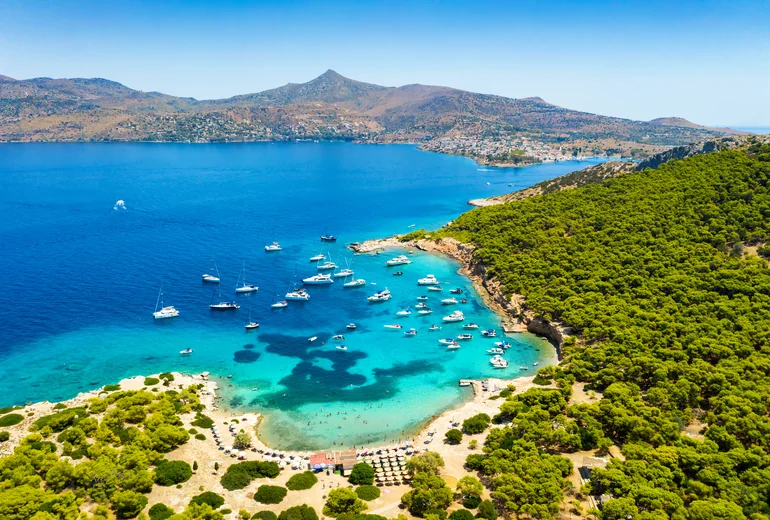
The meltemi is the dominant feature of Cyclades summer sailing. Northerly wind, 4-6 Beaufort typically, occasionally 7 Beaufort (28-33 knots) in mid-July and early August. The pattern: builds from late morning (10:00-11:00), peaks mid-afternoon (14:00-17:00) at full strength, drops at sundown. Around Paros specifically, the meltemi accelerates off the island’s central ridge and is strongest on the east coast (Pounta, Golden Beach, Piso Livadi) and weakest on the lee south coast (Aliki, Antiparos channel). Operational rule for a Paros charter: sail in the morning (departure by 09:00), arrive at the next anchorage by 13:00, ride out the afternoon at a sheltered bay, dinner ashore in calm post-sunset conditions. Crews who try to sail in mid-afternoon meltemi get punished by the build-up; crews who plan around the morning window enjoy the route.
May–early June: water at 18-21°C, anchorages empty, meltemi not yet started. Smart window for sail-first crews. Late June: water at 22-23°C, meltemi beginning, prices 15-25% under peak. July–August: peak meltemi (25-35 knots for days), Naoussa harbour at capacity. September: locals’ month, water at peak (24-25°C), meltemi fading, prices dropping — the single best month if you can pick. Best time of year to charter covers the full pattern.
Free anchoring is permitted on unmarked sand-bottom bays. Posidonia restrictions apply in marked seagrass zones — Greek charter boats now carry the official Posidonia maps; use them before dropping. Marina nights at Parikia, Piso Livadi and Antiparos are paid (€30-80 in season). Despotiko anchoring is permitted but seasonal-restricted near the active archaeological dig.
For a 7-day mid-June 2026 Cyclades charter visiting Paros, crew of 8 on a 45-foot catamaran from Mykonos or Athens-Lavrio: boat charter €12,000-16,500, plus fuel €700-1,000, TEPAI €130-180, marina overnights €180-280, provisioning €1,000-1,300, dinners ashore ~€1,280 — total ~€15,290-20,540 (€1,910-2,565 per person). Add a hostess at €1,300-1,500 or a skipper at €1,750-2,000. Peak-summer weeks book by November of the preceding year for premium catamaran inventory. See the cost of a week on a catamaran in Greece and how far in advance to book.
Mostly yes — free anchoring is permitted on sand bottom in unmarked bays, with posidonia (seagrass) restrictions in marked protected zones. Use the official Posidonia map app, available on most charter boats at handover. Marina nights at Parikia, Piso Livadi, and Antiparos are paid.
Mid-July through early August, 4-6 Beaufort typically, occasionally 7 Beaufort (28-33 knots). The meltemi peaks mid-afternoon and drops at sunset. Around Paros specifically, the east coast (Pounta, Golden Beach, Piso Livadi) sees the strongest acceleration; the south coast (Aliki, Antiparos channel) stays calmest.
Most Paros charterers arrive on a wider Cyclades route from Mykonos new port, Paros itself (Parikia marina, limited fleet), or Athens-Lavrio. Direct charter pickup on Paros is rarer than Mykonos or Athens; check operator-specific availability if a one-way is essential.
Yes — the 1 NM crossing is the shortest inter-island hop in the Cyclades, the Antiparos chora is smaller and quieter than Naoussa, and the Cave of Antiparos is a unique excursion. Combine with Despotiko for a 2-day Antiparos-area mini-route inside the wider Paros week.
For comfort yes — catamarans run flatter in meltemi conditions and reduce seasickness on the longer Cyclades crossings. For pointing performance, monohulls beat catamarans upwind. Family and group charters universally favour cats around Paros; sailing-first 4-person crews sometimes prefer monohulls. How do I choose the right catamaran covers the format choice.