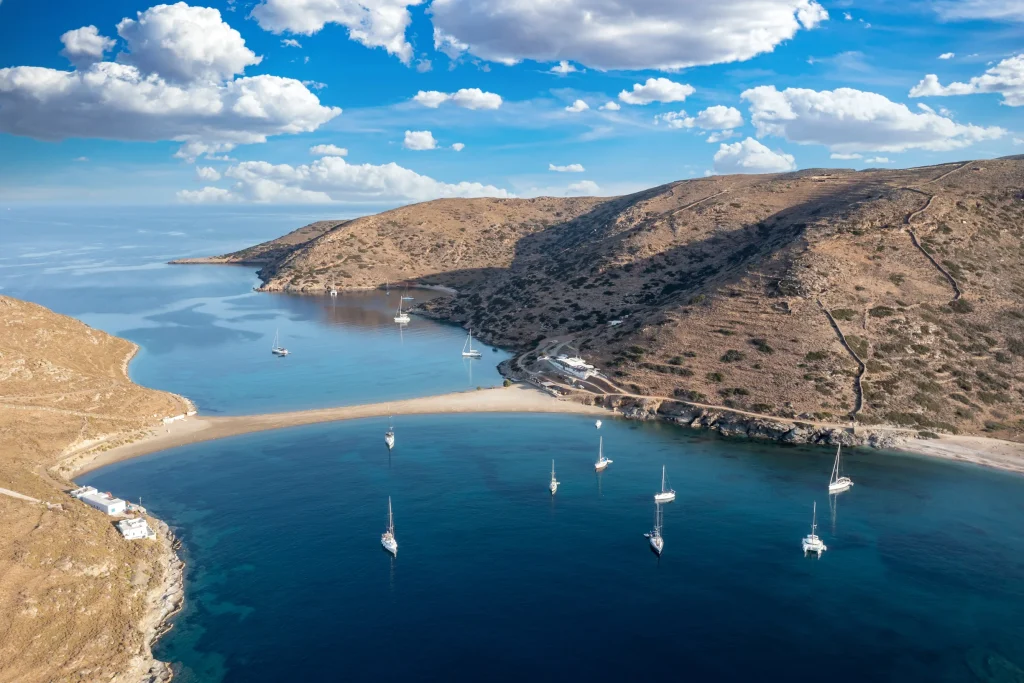
Kea & Kythnos: The First-Night Islands Every Lavrion Charter Should Slow Down For
Why the two islands closest to Lavrion deserve your first two nights, not a quick wave on the way to Mykonos.
Read more
You don’t need a full week to get out on the water from Athens. A short sailing trip from Athens, three or four days through the Saronic Gulf, gives you four genuinely different islands without a single long passage. It’s the route Athenians themselves take for a city break with sea air, and it works beautifully as a tagged-on weekend before or after a flight.
The classic loop runs Aegina, Agistri, Poros and Hydra, all within easy reach of the marinas at Alimos and Athens. Short hops, sheltered water most of the time, and a different character at every stop: temples and pistachios on one island, a pine-clad strait on the next, car-free stone harbours on the last. Here’s how to make it fit a long weekend, and what you give up by going short instead of long.
Geography does the work here. The Saronic Gulf sits right outside Athens, so you lose almost no time getting to the good stuff. From Alimos marina you can be anchored off Aegina in two to three hours. Compare that with a Cyclades charter, where the first day is largely about reaching the islands at all, and you can see why the gulf is the obvious pick for anything under five days.
The gulf is also more forgiving in the wind. When the meltemi howls through the central Aegean in summer, the Saronic stays comparatively calm, tucked behind the Peloponnese and the Attica coast. By September the breeze is gentler everywhere, but the gulf remains the low-stress option, which matters when you’re trying to relax rather than rack up sea miles. If you want the detail on conditions, our guide to sailing weather in the Saronic Gulf covers the seasonal picture.
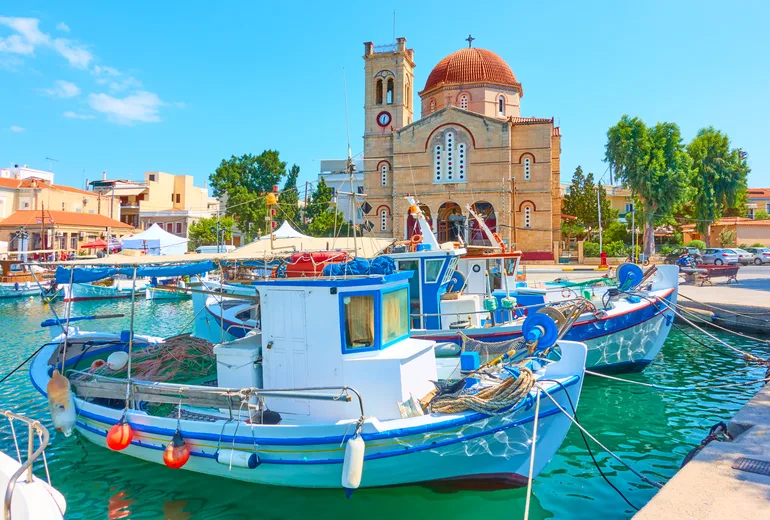
Pick the boat up at Alimos in the morning, provision, and aim to clear the marina by lunchtime. Aegina is the first proper island, about 17 nautical miles out, two to three hours under sail. The town harbour is busy and shallow in places, so many catamarans prefer to anchor off in the bay or moor stern-to with care. Ashore, Aegina is famous for its pistachios, sold from stalls all along the front, and for the well-preserved Temple of Aphaia up in the hills if you fancy a taxi ride and a look.
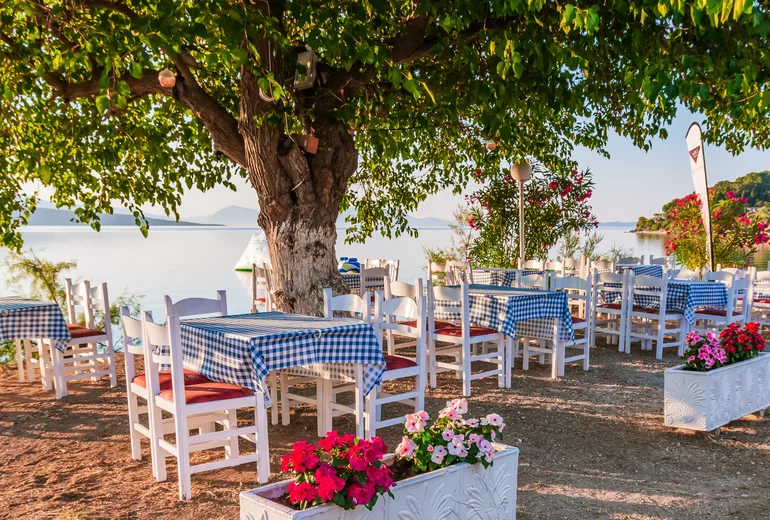
For a quieter night, slip across to neighbouring Agistri, just a couple of miles southwest. Skala and the anchorages around Aponisos have clear water over sand and a fraction of Aegina town’s bustle. It’s a five-minute detour that buys you a calmer evening and a swim straight off the back of the boat.
While you’re on Aegina, the pistachios are worth a stop in their own right; the island’s PDO-protected nuts are sweeter and softer than the supermarket sort, and a bag from a waterfront stall is the classic boat snack for the week. If you want to stretch your legs, the Temple of Aphaia sits on a pine ridge in the island’s east, one of the best-preserved ancient temples in Greece and a short taxi from the port. Most crews give Aegina an afternoon ashore and an evening anchored off, then push on south the next morning while the sea is calm.
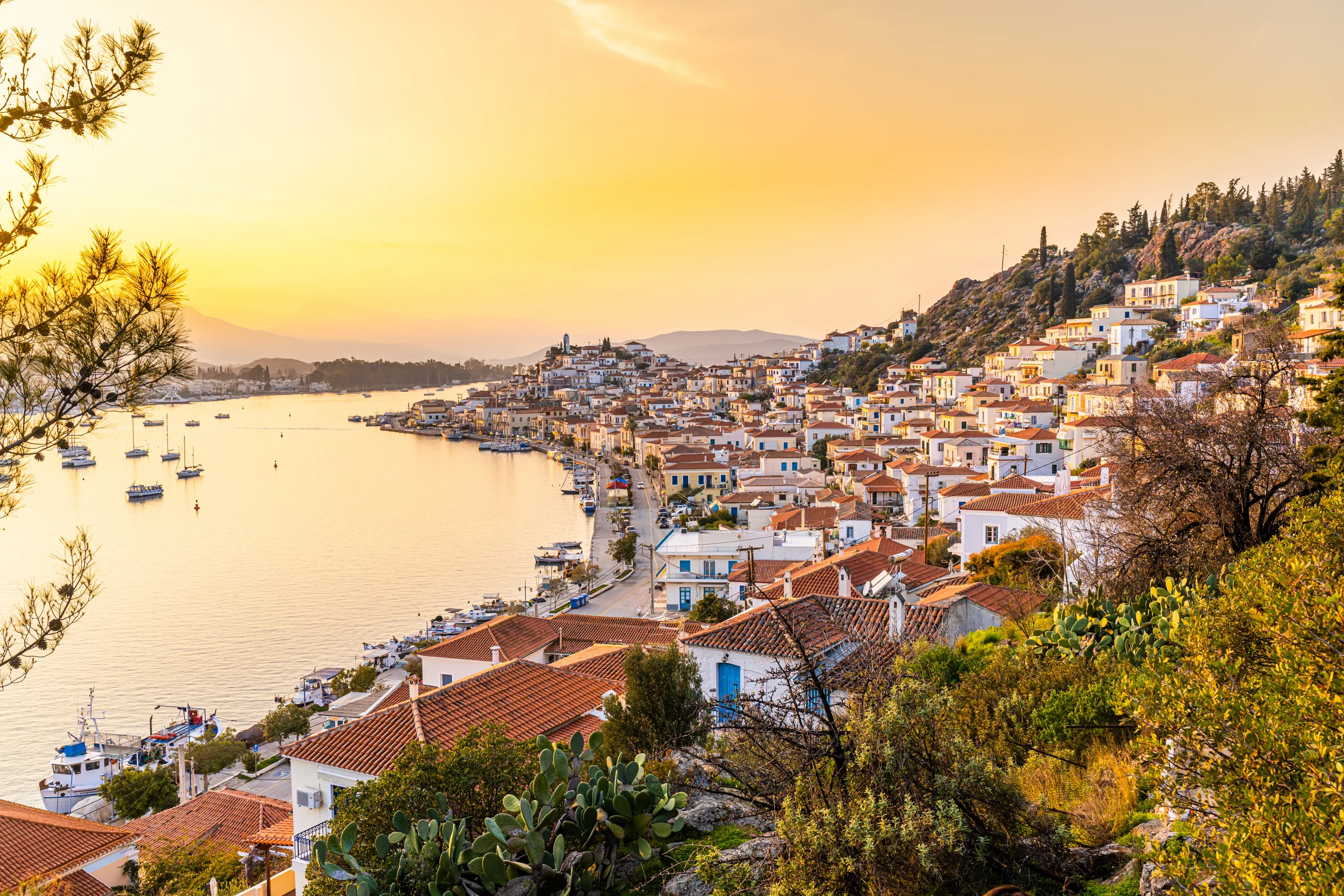
From Aegina or Agistri, point south for Poros, roughly 20 nautical miles, three hours or so. The approach is the highlight: Poros sits across a narrow, sheltered channel from the Peloponnese mainland, the strait so tight it feels like sailing up a river lined with pine and lemon groves. The town climbs a hill topped by its landmark clock tower, and the waterfront is one of the prettiest in the gulf at golden hour.
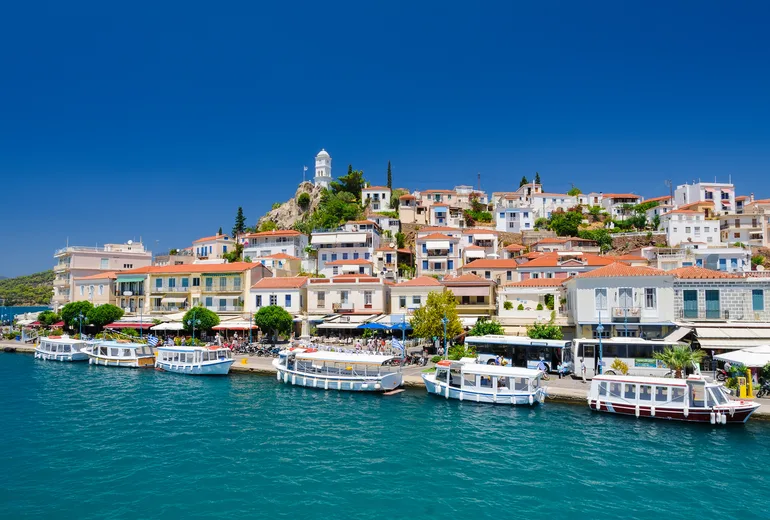
You can med-moor along the town quay or anchor in the bays around the strait, such as Russian Bay (Ormos Vidi) a short way west, which has good holding in sand and a calm, leafy feel. Dinner ashore in Poros runs around €20–30 a head; the fish tavernas on the front do well-priced grilled catch, and the gelato near the clock tower steps is a local institution. This is the easy middle of the trip, with the shortest passages and the most sheltered anchorages.
Poros also makes a good provisioning point if you under-bought at the start. There’s a proper supermarket a couple of streets back from the quay, a baker for fresh bread in the morning, and a fish market where you can buy the day’s catch to grill on board. With the mainland just across the strait, water and fuel are easy here too, so it’s a sensible spot to top up tanks before the run to Hydra. If the wind is light, the bays on the Peloponnese side, like Vagionia, give you a quiet lunch stop and a swim before you commit to the town for the night.
A three-day trip can turn around at Poros and run back via Aegina. But if you’ve got a fourth day, push on to Hydra. It’s the island that makes the loop memorable, and it’s worth rearranging flights for.
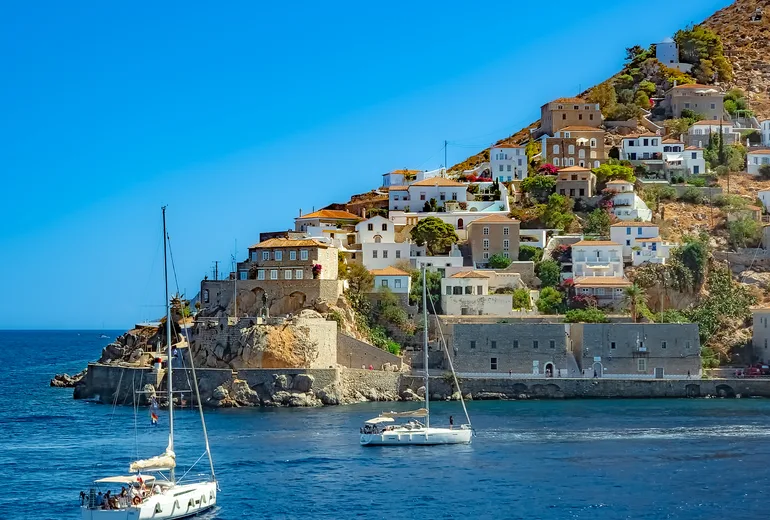
Hydra is about 12 nautical miles from Poros, under two hours. The island bans cars entirely, so the only traffic is donkeys, water taxis and the boats packed gunwale to gunwale in the horseshoe harbour. Arriving by sea is the whole point. The grey-stone mansions rise straight up the slopes around the port, and the effect from the cockpit as you come in is hard to beat.
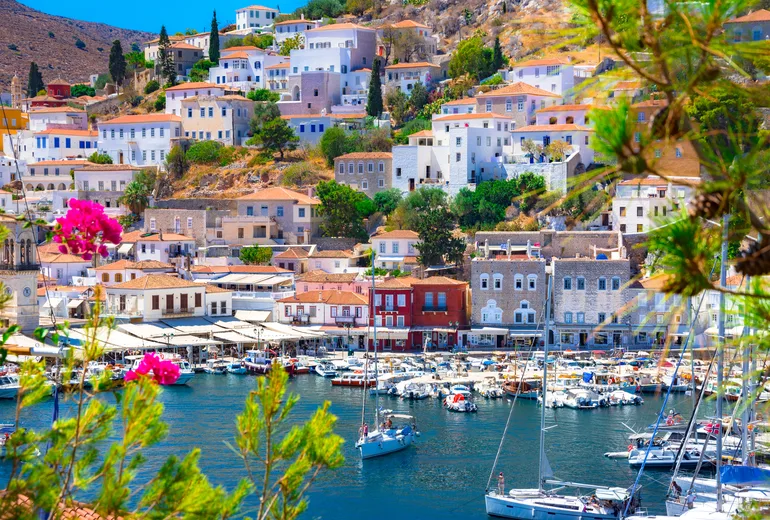
A word of honesty: Hydra’s harbour is small and gets very full in season, and a big catamaran can struggle to find a berth on the quay. Many crews drop the hook just outside the harbour entrance or in nearby Mandraki bay and take the dinghy in, which is often the calmer choice anyway. Once ashore, the waterfront cafes, the cannon-lined ramparts and the walk out to the swimming spots at Spilia and Avlaki are all within easy reach. Our deeper dive into mooring and anchorages around Hydra and Spetses is worth reading before you go, because the berthing situation rewards a plan B.
Charters are normally priced by the week, Saturday to Saturday, but plenty of operators in the Saronic offer short breaks of three or four days outside the July–August peak. Expect a long-weekend catamaran to cost somewhere in the region of €1,500–3,500 depending on the size and age of the boat, plus fuel, end cleaning and any extras. That’s not a pro-rata third of a weekly rate; short charters carry a premium per day because the boat still needs turning around. September and October are the sweet spot, when demand drops, the water is still warm, and operators are more flexible about filling gaps between weekly bookings.
Two practical points make short charters smoother. First, ask whether the price is all-in or whether fuel, the final clean and tourist tax are extra, because those add up on a short trip where the base cost is already higher per day. Second, check the start and end times: a Friday-afternoon pick-up and a Monday-morning drop-off gives you three full days on the water, whereas a late start and early return can quietly eat half a day at each end. A good operator will be upfront about both.
What you trade by going short is range, not quality. You won’t reach the Cyclades or sail far into the Peloponnese, and you’ll be back at base before the rhythm of life aboard fully sets in. What you gain is a low-commitment few days that delivers four real islands. If the bug bites, the same gulf opens out into longer routes: the full 7-day Saronic islands itinerary adds Spetses, Ermioni and the mainland coast to everything above.
The shoulder months either side of summer are the sweet spot for this loop. Late September and October bring warm sea, soft light and quiet harbours, while May and early June offer the same calm with greener islands. July and August work too, but the Saronic gets busy and the town quays at Hydra and Poros fill early, so you’ll anchor off more often.
As a route, this suits a few different crews. It’s forgiving enough for a first bareboat charter, with short legs and sheltered water, yet varied enough that an experienced skipper won’t be bored. It also works as a tasting menu: couples wanting a romantic few days, friends tagging sailing onto an Athens city break, or families testing whether a longer charter is for them. The low passage distances mean nobody spends the trip feeling queasy or stuck at the helm.
The Saronic Gulf loop of Aegina, Agistri, Poros and Hydra is the standout for a short trip. The islands are close together, the passages are short and sheltered, and each has a distinct character. You can do a tidy version in three days by turning around at Poros, or add Hydra for a fuller four-day weekend.
Three days covers Aegina and Poros comfortably, with time to swim and eat ashore at each. Four days lets you add Hydra without rushing, which most crews feel is the version worth doing. Anything shorter than three days and you’ll spend more time moving than relaxing.
Yes, particularly off-season. Many Saronic operators offer three- and four-day charters outside July and August. Per-day pricing is higher than a weekly rate because the boat still needs cleaning and turnaround, but September and October bring more availability and better flexibility on dates.
Generally, yes. The Saronic sits sheltered behind the Peloponnese and the Attica coast, so it escapes the worst of the summer meltemi that funnels through the central Aegean. That makes it the more relaxed choice for short trips, families and less experienced crews.
Hydra’s main harbour is small and crowds quickly, and large catamarans often can’t find a quay berth in season. The common solution is to anchor just outside the entrance or in nearby Mandraki bay and use the dinghy to reach town. It’s usually the quieter option regardless.
Tempted to turn a city break into a sailing one? Explore our full range of catamaran charter destinations from Athens and pick the loop that fits your weekend.