Catamaran Charter vs Ferries + Hotels in Greece: The Per-Person Maths for 6-8 People
A real per-person spreadsheet comparing a 45 ft catamaran split eight ways against ferries and hotels for the same Cyclades week.
Read more
Greece vs Croatia sailing is the argument that fills charter forums every winter, and most of the answers are tribal. Here’s a more useful one: the right choice depends almost entirely on what kind of crew you are and how much wind and distance you actually want to deal with.
We charter in Greece, so treat this as our-side-but-honest. There are real cases where Croatia is the better call — especially for first-timers — and we’ll name them. But for the right crew, the Greek islands offer a sailing experience Croatia simply can’t match. Let’s go traveller type by traveller type.
This is the single biggest difference, and it shapes everything else. Greece’s summer wind, the meltemi, blows from the north and can hold 25–35 knots for days at a stretch in July and August. It’s a proper sailing wind — exhilarating downwind, punishing upwind — and it demands a crew that can read a forecast and pick its days.
Croatia’s maestral is gentler: a thermal sea breeze that typically fills to 12–18 knots in the afternoon and dies at night. It’s forgiving, predictable, and rarely traps you in harbour. For a relaxed shakedown or a nervous crew, that matters enormously. Our deeper look at notes on sailing conditions in the calmer Ionian, which is the Greek region most like Croatia.
Greece is an anchoring country. The Cyclades are studded with bays where you drop the hook for free, swim off the stern, and dinghy ashore for dinner — many nights you never touch a quay. It’s wilder and cheaper, but it asks more of your ground tackle and your nerve.
Croatia is denser and more developed. The islands sit close together, marinas are everywhere, and a lot of crews take a berth most nights — water, power, a restaurant on the quay. That convenience comes at a price: Croatian marina fees are among the highest in the Med, and a busy ACI marina in August can cost €100–200 a night for a 45 ft cat. In Greece you can largely sidestep that bill by anchoring.
Croatia packs more islands into less water. From a Split base you can island-hop with two- to three-hour legs and never feel rushed — Brač, Hvar, Vis, the Pakleni islets all within an easy day. Greece spreads out: a Cyclades crossing can be 25–40 NM in open water, and the meltemi makes those legs serious. If your group wants short, low-commitment hops, Croatia is genuinely easier to sail.
That said, density cuts both ways. Croatia’s popular anchorages and marinas can be heaving in August — Hvar town and the Pakleni islets get genuinely crowded, and the best berths fill by early afternoon. Greece’s spread means that even in peak season you can find an empty bay if you’re willing to sail a little further. The Cyclades reward effort with solitude; the Adriatic rewards ease with company.
Both eat well, but differently. Greek island food is taverna-simple and excellent — grilled fish by the kilo, Sifnos chickpeas, Naxos cheese, wine from the barrel. Croatia leans Italian-Adriatic: black risotto, peka (meat slow-cooked under a bell), Pošip and Plavac Mali wines from Hvar and Pelješac. Croatia’s restaurant standard is arguably more polished; Greece’s is rougher and, for many, more soulful.
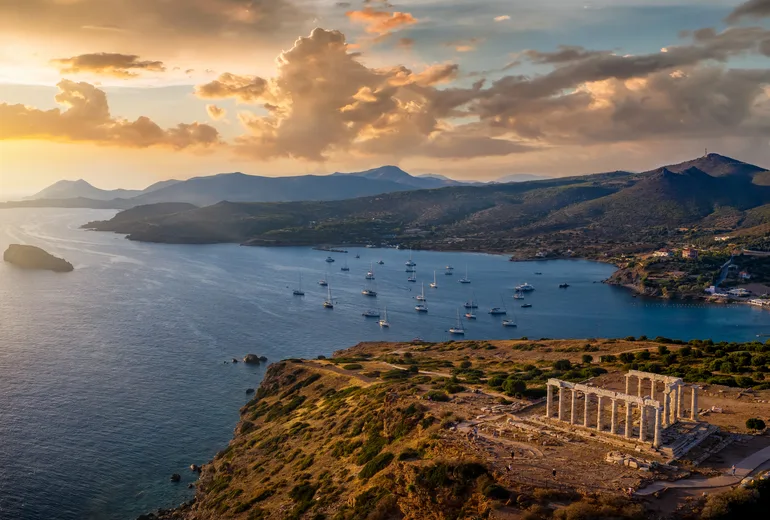
Culturally, Greece offers the deeper layer — ancient sites you sail right up to, like the Temple of Poseidon at Sounion or the marble Portara on Naxos. Croatia counters with walled medieval towns: Dubrovnik, Korčula, Trogir. Different flavours of history; neither is “more”. For a sense of how the Greek grounds differ from each other, our Cyclades, Ionian and Saronic comparison is the place to start.
The shore rhythm differs too. In Greece, an evening often means dropping the hook, dinghying in to a beach taverna, and walking back to the boat under the stars — the island is a backdrop, the boat is home. In Croatia, you’re more likely to be moored on a town quay with the restaurants and bars a few steps away, the boat parked while the town becomes the evening. Neither is better; they’re simply different holidays. Decide which version of “evening” you actually want, because you’ll have fourteen of them.
Boat hire is broadly comparable across the two countries for the same catamaran, with Croatia often slightly higher in peak August. The differences show up in the running costs.
Marina fees and the marina-every-night habit add up fast in Croatia — €600–1,200 a week in berths is normal. Croatia also charges a tourist tax and sojourn fee per person, and some areas levy national-park entry (Kornati, Mljet). Provisioning is similar to Greece.
Flights are the swing factor. For most of northern Europe, Split and Dubrovnik are cheaper and faster to reach than Athens, and far cheaper than connecting onward to a Greek island base. Greek inter-base relocation and one-way fees also tend to run higher. So your travel budget can tilt either way before you’ve even boarded.
Eating and drinking ashore is broadly similar in price, with Greece edging slightly cheaper on the quieter islands and Croatia’s polished restaurants in Hvar or Dubrovnik climbing higher. Wine is a small win for Greece if you drink the local barrel stuff; Croatia’s bottled Plavac Mali is excellent but pricier. None of this moves the needle as much as the flights and the marina habit do.
Here’s the honest sort, by crew type. There’s no universal winner — there’s a winner for you, and it depends on your experience, your group and what you’re actually after on the water.
If this is your first bareboat charter, be honest about your comfort with wind and the open sea. Croatia’s gentler conditions and short hops make it the lower-stress place to learn, and the dense marina network means there’s almost always a safe berth within an hour. Greece can absolutely be a first charter — the Ionian and Saronic gulfs are forgiving — but the open Cyclades in high summer are not where most people want to discover what 30 knots feels like. Match the destination to your nerve, not your must-do.
You’re a first-time charterer or a nervous crew; you want short hops and a marina most nights; you’re flying from northern or central Europe and want cheap, direct flights; or you simply prefer predictable afternoon breezes to the meltemi’s moods. For a gentle introduction to Adriatic sailing, our friends at Catamaran Charter Croatia cover those grounds in detail.
You want real sailing and the freedom of anchoring; you’d rather wake in an empty cove than on a marina quay; you love the idea of sailing up to a 2,500-year-old temple; or you want islands that still feel rougher and less packaged. The meltemi is the price of admission, and for the right crew it’s the best part. If that’s you, our Greek catamaran destinations are the next stop.
Croatia, generally. The maestral is gentler than the meltemi, the islands sit closer together so legs are short, and marinas are plentiful if you want a safe berth every night. Greece can absolutely be done by beginners — the calmer Ionian especially — but the Cyclades in high summer reward experience.
It depends on how you sail and where you fly from. Boat prices are similar, but Croatia’s high marina fees and per-person taxes push running costs up, while Greece’s anchoring culture keeps them down. Flights usually favour Croatia from northern Europe, which can erase the on-the-water savings. Run your own numbers both ways.
For a nervous or inexperienced crew in July and August, yes — it’s a legitimate reason. The meltemi can blow hard for days and confine you to harbour. But it’s also what makes Greek sailing thrilling, and it’s far milder in the Ionian and in the shoulder months of May, June and September.
Yes, both offer one-way options for a relocation fee. In Greece the classic downwind run is Athens to Rhodes; in Croatia, Split to Dubrovnik. One-way fees tend to be higher in Greece because the distances and logistics are greater, so factor that in if a point-to-point passage appeals.
Still torn? Browse our Greek catamaran charter destinations and we’ll talk you through whether Greece really fits your crew, honestly.