Two Weeks, One Loop: The Complete Cyclades Catamaran Circuit for 2027
The complete two-week Cyclades catamaran loop from Athens, with layover days built in to absorb the meltemi.
Read more
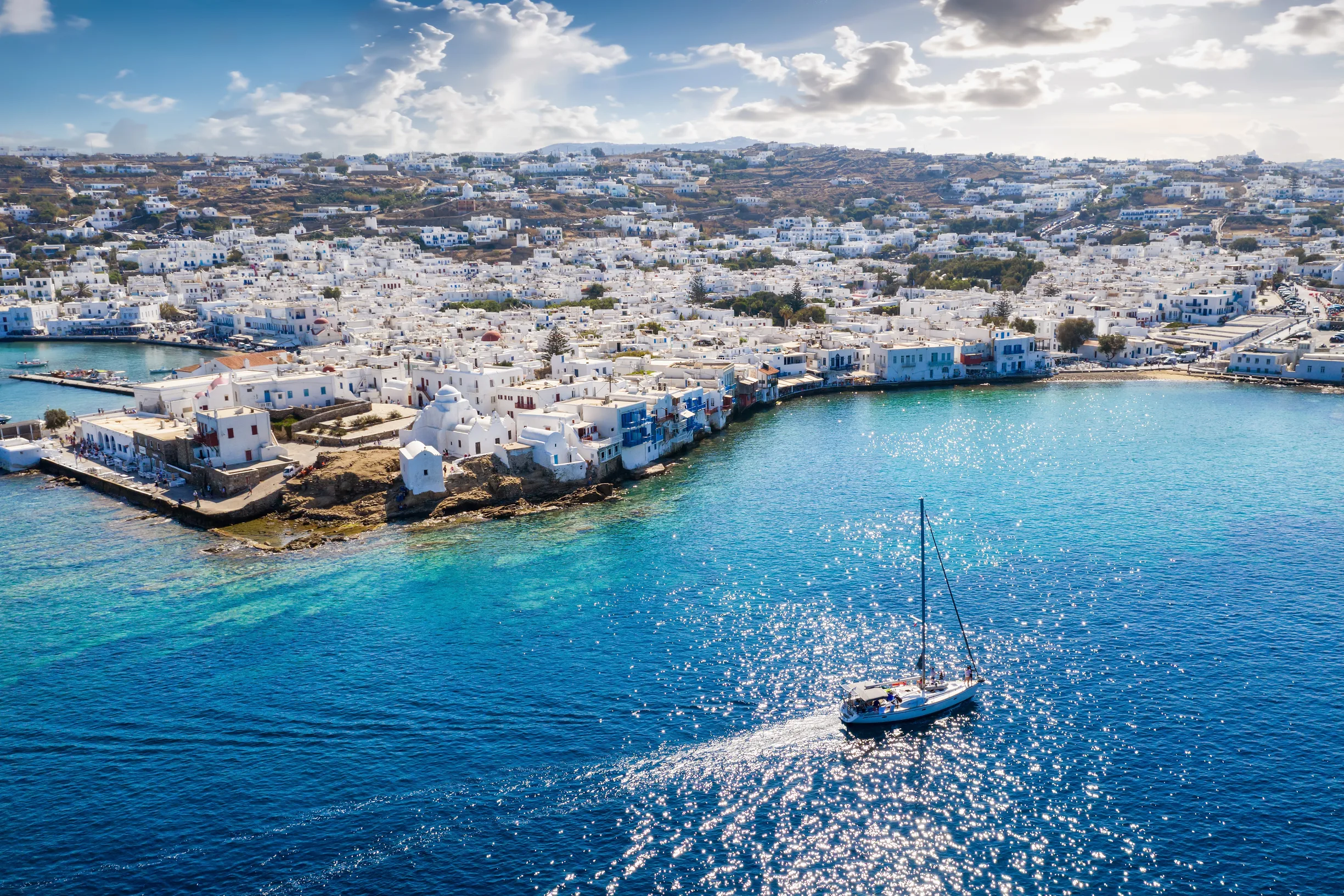
Mykonos sits two miles from one of the most important archaeological sites in the Mediterranean, yet most visitors only see Delos crammed onto a midday day-boat. On a catamaran you can do far better. The key is understanding the rules: you cannot stay overnight at Delos itself, but the neighbouring island of Rineia gives you a sheltered, almost empty delos rineia anchorage within easy reach of the ruins.
This is the crew’s guide to doing the sacred island properly — the landing and ticket logistics, why overnighting means crossing to Rineia’s coves, and how a cat lets you walk the marble streets in the cool of early morning before the first ferry from Mykonos arrives.
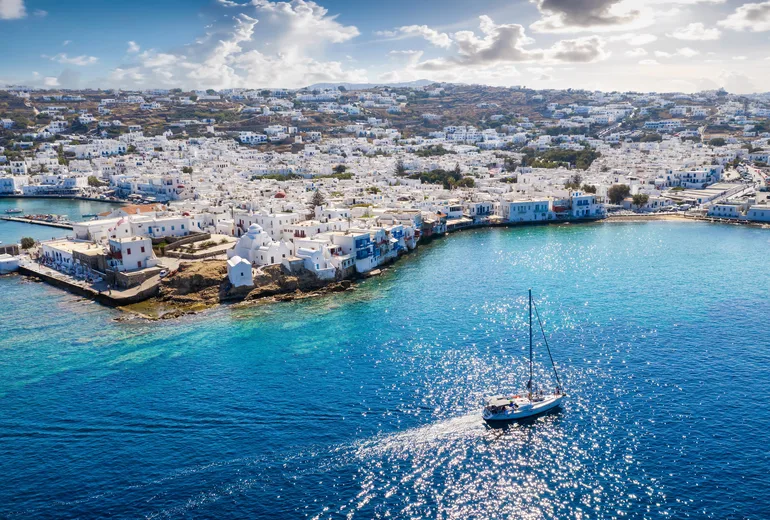
Delos is an uninhabited open-air museum and a strictly protected site, so the constraints are real. You cannot anchor off Delos overnight, you cannot stay on the island after closing, and access is controlled. Most charter crews tie up briefly at the small jetty on the west side or take their tender in, but berthing space is limited and the authorities prioritise the licensed excursion boats. The simplest, lowest-stress approach is to anchor at Rineia, then visit Delos by tender or by catching one of the regular Mykonos day boats that call there.
You pay an entrance fee to land — around €12 in recent seasons, with the small site museum included — and the site keeps museum hours, typically opening around 8am and closing in the early afternoon in summer. There is almost no shade and no real shop, so carry water, sun cover and decent shoes for the rough marble. Wardens are present and the protected status is enforced, so treat it as the living archaeological reserve it is.
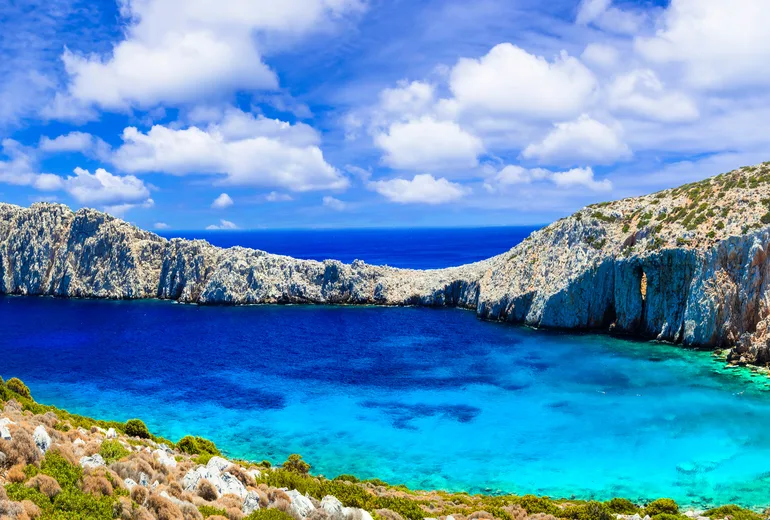
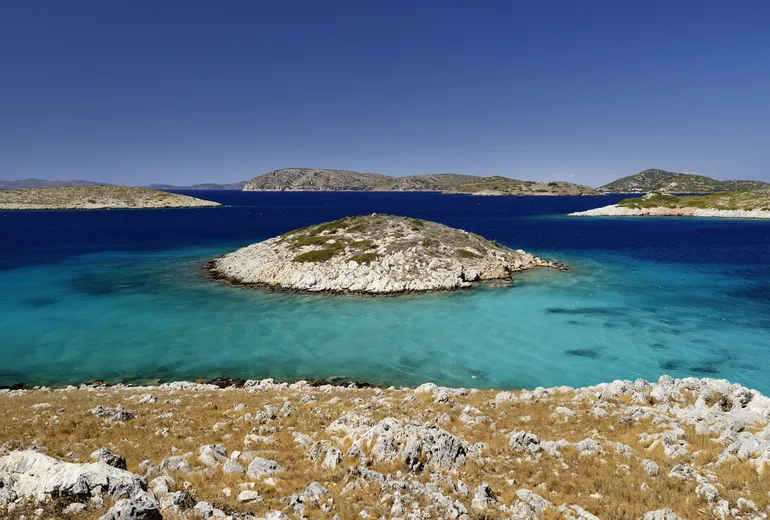
Rineia is the larger, barren island immediately west of Delos, separated by a narrow channel. Nobody lives there, there is nothing to buy, and that is exactly the point. Its east and south coasts are scalloped with shallow, sandy coves that offer some of the calmest holding in the central Cyclades — a rare commodity when the meltemi is funnelling between the islands. For a shallow-draft catamaran this is ideal water: you can tuck close in over clean sand where the deep-keeled monohulls cannot, and that is what makes a Rineia anchorage so much more useful than trying to linger off the sacred island itself.
The best-known anchorages are the bays along Rineia’s southeastern shore facing the channel, where you get protection from the prevailing north wind and a flat night under a sky with no light pollution at all. Holding is generally good in sand, but read the bottom and avoid the seagrass; in a strong meltemi the gusts still curl over the low island, so lay plenty of chain and set a swing alarm. From here the lit-up sprawl of Mykonos glows on the horizon while your own cove stays silent.
Choose your cove by the day’s wind. With the typical northerly, the south-facing bays of Rineia are calmest; if the wind has any west in it, shift toward the more sheltered eastern indentations. The channel between Delos and Rineia itself can be anchored in settled weather but accelerates in fresh meltemi, so it is a fair-weather option only. As always in the Cyclades, the wind is the whole story — our breakdown of shallow-draft anchorages around Greece covers how a cat’s draft opens up coves like these that monohulls have to skip.
Here is the reward for all this planning. Anchor at Rineia the evening before, swim in an empty cove, and have dinner aboard. In the morning, before the 9am day boats churn over from Mykonos, take your tender across to Delos for the opening or visit the moment the site unlocks. You walk the Terrace of the Lions, the House of Dionysus mosaics and the Sacred Way with the light still soft and the marble cool, sharing it with a handful of people instead of a thousand. By the time the first ferries disgorge their crowds you are climbing Mount Kynthos for the view, or already back aboard for a swim.
This is the single best argument for visiting Delos by private boat. The site is extraordinary at any hour, but in the early cool, half-empty, it lands completely differently. Plan your timing around the heat too: by late morning the unshaded ruins become punishing in August, so an early start is comfort as much as crowd-avoidance. Give yourself a couple of hours ashore to do it justice — the theatre quarter, the museum and the climb up Mount Kynthos for the panorama over the Cyclades all reward time rather than a rushed circuit.
Delos and Rineia slot neatly into the standard Cyclades loop. From a busy Mykonos night — Ornos or the new-port quay — it is a short two-to-three-mile hop to the Rineia coves, making it the perfect antidote the day after the bars. Many crews do Mykonos for the scene, then retreat to Rineia for two nights of calm and culture before pushing on to Paros, Naxos or Tinos. For the island itself, our roundup of the best things to do in Mykonos covers what to keep and what to skip, and the wider route is laid out in our 7-day Cyclades itinerary from Mykonos.
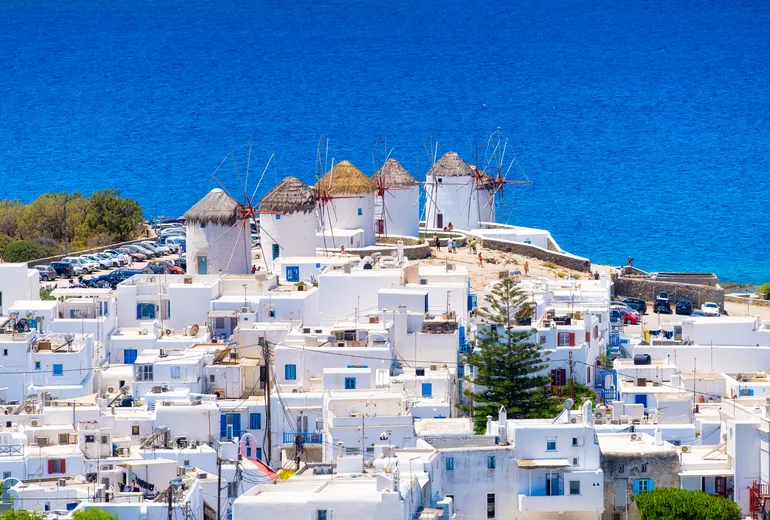
It pays to know the coves before you arrive rather than nosing in blind at dusk. The most-used anchorages line Rineia’s southeastern shore facing the Delos channel, where a string of sandy bights give protection from the prevailing north wind. The largest, sometimes called Ormos Skinou and the bays near Cape Mira, have room for several boats to swing and clean sand patches between the weed. Further north, the indentations toward Stena and the channel narrows are calmer in a westerly slant but feel the meltemi’s acceleration when it is fresh, so they are best kept for settled days.
Depths in the prime coves run a comfortable 3–7 metres over sand, which is exactly where a catamaran wants to sit: close in, shallow, and out of the swell line. Drop where you can see the pale rippled bottom, back down firmly to set, and give yourself swinging room from the rocky edges. In a building northerly the gusts curl over the low spine of the island in williwaws, so more chain rather than less is the rule, and a tripping line is worth rigging if the bottom is patchy. Treat the whole delos rineia anchorage as a fair-weather-to-moderate option; in a full meltemi gale you are better off running the two miles back to the shelter of Mykonos, where the new port quay and Ornos give all-round protection. Pick your night by the forecast rather than the postcard, and the coves reward you with the calmest sleep in the central Cyclades.
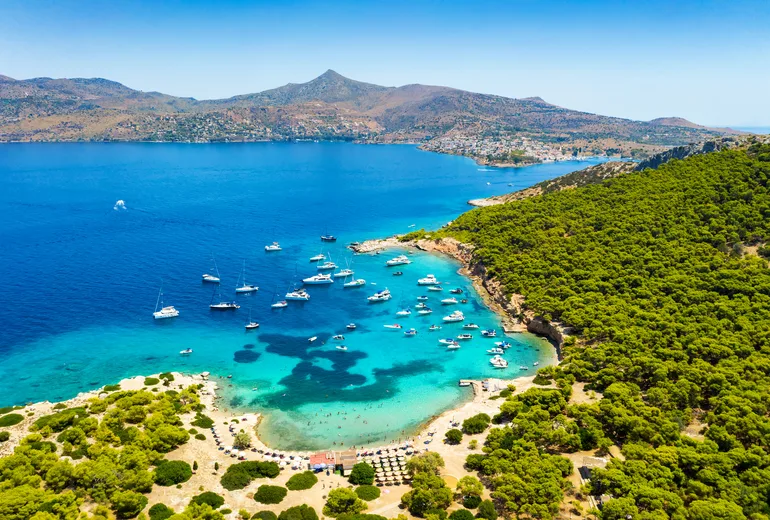
Because you visit Delos from the Rineia side, the tender becomes your ferry. The channel is short — well under a mile at the narrowest — but it can kick up a sharp chop when wind opposes the current, so cross early when it is glassy rather than at midday. Land at the official jetty area on the west of Delos, not on the protected shores, and keep your tender clear of the excursion-boat berths. Carry your ticket, water and a dry bag for valuables, and time the return so you are back aboard before the afternoon breeze makes the crossing wet. None of it is difficult, but it rewards an early start and a calm-weather window.
A handful of things keep the visit clean and legal. Do not attempt to overnight at Delos or land outside opening hours; the protection is taken seriously and fines follow. Carry your entrance ticket, plenty of water and sun cover, because there is no shelter on either island. Anchor only on sand at Rineia, never in seagrass, and keep a weather eye on the meltemi — the low islands give shelter from the sea but not always from the gusts, so be ready to shift coves or run for Mykonos if it pipes up. Leave nothing ashore on Rineia; there are no facilities and the islands stay pristine because crews carry everything back.
Yes, but you cannot stay overnight at Delos or use it as an anchorage. You can land by tender or at the small jetty during opening hours, paying the entrance fee, though berthing is limited and excursion boats get priority. Most crews anchor at neighbouring Rineia and visit Delos from there.
At Rineia, the uninhabited island just west of Delos. Its southeastern and eastern coves offer sandy, sheltered holding that is calm in the usual northerly meltemi, ideal for a shallow-draft catamaran. There are no facilities, so it stays quiet and dark while Mykonos glows across the water.
The site entrance has been around €12 in recent seasons, including the small museum. There is no charge to anchor at Rineia. Bring cash, water and sun protection, as there are no shops or shade on either island.
Early morning, before the day boats arrive from Mykonos around 9am. Anchoring at Rineia the night before lets you cross at opening and walk the ruins in cool, soft light with few people, then beat the worst of the midday heat on the unshaded site.
Generally yes, in the coves facing away from the prevailing north wind, where holding in sand is good. The low island shelters you from the sea but strong gusts can still curl over it, so lay plenty of chain, set a swing alarm and keep a fallback option toward Mykonos if the wind builds.
Want to build a Cyclades week with calm culture as well as the famous islands? See current boats and dates on our Greece catamaran destinations page and pencil in two quiet nights at Rineia beside the ancient world.