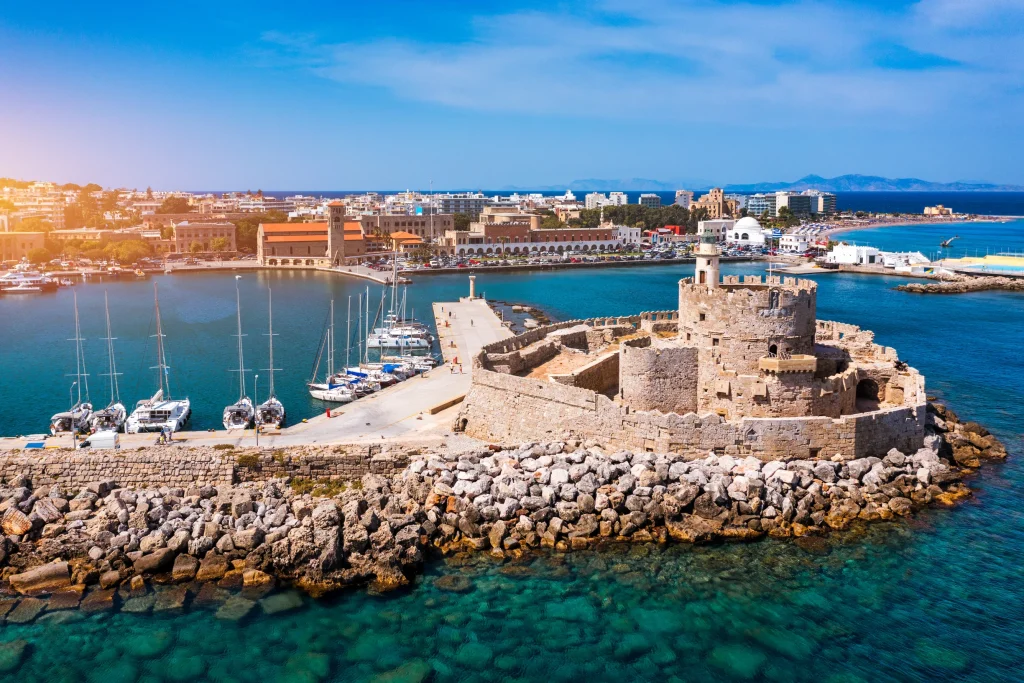
The Great Aegean One-Way: Athens to Rhodes by Catamaran in 10 Days (2027 Season)
Ride the meltemi downwind from Athens to Rhodes in 10 days, the one Greek passage where a one-way fee pays for itself.
Read more
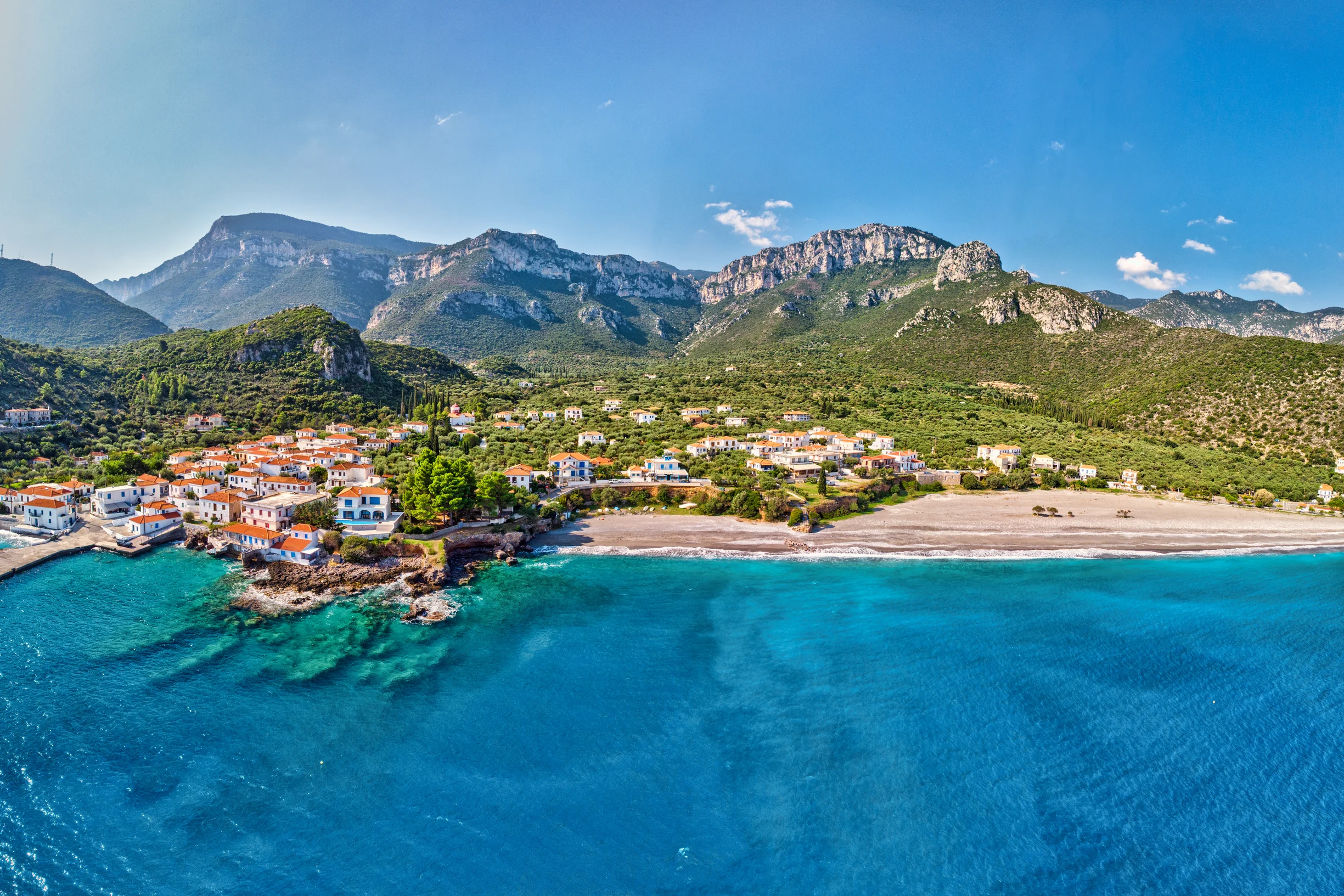
Updated May 2026.
Your itinerary is a suggestion, not a contract. The 7-day Cyclades loop you saw on a brochure, the Saronic week your friends raved about, the Ionian route in the magazine — all of those are starting points. The actual route on your charter is set 24-48 hours ahead by the forecast, and the call on whether to sail it belongs to your skipper. This guide is meant for anyone considering a Greek catamaran charter who hasn’t yet booked — we want you to understand the weather reality before you sign the contract, not on the morning of day 2 when the Meltemi is blowing 30 knots and your skipper has just told you the Cyclades crossing is off.
Recently a guest of ours chartered from Athens hoping to reach the Cyclades on a 7-day window. The Meltemi forecast called for sustained 30-knot+ winds over three days starting day 2, with no easy refuge mid-archipelago. Their skipper called the route off — offered a Saronic Gulf alternative instead. The guest was initially disappointed; by the end of the week they were thanking him. That story is the heart of this post.
This isn’t a polite tradition; it’s how the system works. A few facts that frame every Greek charter:
The charter agreement. Every Greek charter contract you sign — bareboat or skippered — gives the operator and the assigned skipper authority to alter the route, return early, or refuse a leg on safety grounds. This is standard ship-master responsibility under maritime law and isn’t negotiable.
Insurance. The boat’s hull insurance and the operator’s liability cover both depend on the skipper following safe-navigation practice. If a skipper sails into a forecast they shouldn’t, the operator’s cover can be voided — meaning damage to the boat would come out of your security deposit (€2,000-5,000) and any third-party liability could land on the guest party.
The skipper’s licence. A professional skipper risks their licence and livelihood if they take an avoidable safety risk. They are not going to sail a forecast they believe to be unsafe just because guests paid for a specific destination.
The practical implication: when your skipper says the Cyclades crossing isn’t safe today, they are protecting your life, your money (charter rate plus security deposit) and the boat. There is no version of the conversation where overruling them is the right move.
The Meltemi (also written meltem, etesian wind) is the dominant Aegean summer pattern. The basics:
— Direction: north-east to north. The wind funnels southward through the Aegean from the Asian thermal-low pattern across Türkiye and the Balkans.
— Season: May through September, with peak intensity mid-July to mid-August. Onset is often sudden — calm morning, 30 knots by mid-afternoon, peak overnight.
— Force: regularly 25-35 knots sustained with gusts to 45 knots+. Multi-day blows of 3-5 days are routine. The Meltemi is not a frontal system you wait out for 12 hours; it sets in and stays.
— Worst areas: central and southern Cyclades — the Mykonos-Paros-Naxos channel, the Cyclades-to-Crete crossing, the Cape Sounion to Kea passage. These are the open-water funnels where the wind accelerates and the fetch builds 2-3 metre short-period seas.
— Why catamarans don’t make it easy: a 45-foot catamaran handles the wind itself fine. The constraint is the sea state — short-period swell across a wide fetch wears down crews and shears refuge windows. Multi-day Meltemi in the Cyclades means choosing between staying in a Cyclades harbour (often crowded and rolly) or making a long passage in big seas.
The Meltemi is forecast reasonably well 48-72 hours out by the major model runs (ECMWF, GFS, the Greek national service Poseidon and the dedicated meltemi.gr aggregator). Your skipper checks all of these the evening before any open-water leg.
Anonymised version of a recent guest experience.
The booking: Lavrion pickup, 7-day catamaran charter, Cyclades target itinerary — Kea, Mykonos, Delos, Naxos, Paros, Antiparos, return. Skipper booked.
The forecast on day 1 evening (Saturday turnaround day, Sunday departure): a Meltemi system building from day 2 onwards, sustained 30+ knots through day 4 with a brief Tuesday window before a second pulse on day 5. The exposed Cape Sounion to Kea crossing — the entry to the route — would face beam seas on the outbound leg and severe gust acceleration off Cape Sounion’s lee. Refuge spacing in the central Cyclades during a Meltemi pulse is narrow; once you commit to a Cycladic harbour you can be stuck there for the duration.
The skipper’s call: route changed to a Saronic Gulf loop — Lavrion → Cape Sounion → Aegina → Poros → Hydra → Spetses → Ermioni → return. The Saronic sits in the protective lee of the Peloponnese mainland, the Meltemi’s effect is reduced by a factor of 3-5 there, and the leg lengths are 12-22 nautical miles — comfortable 3-4 hour sails instead of open-water crossings.
The conversation: guest disappointment was immediate. They had specifically come for the Cyclades. The skipper walked them through the forecast on the chartplotter, showed the wind-rose model for each of the next 5 days, and explained why he couldn’t sign off on a Cape Sounion departure under those conditions. The Saronic alternative was framed as the smartest available trade-off, not a consolation.
The outcome: the guests sailed the Saronic loop, ate at Hydra’s harbour-side tavernas, anchored off the Spetses old port, and emailed us the following week thanking the skipper for the call. They are re-booking for June 2027 — specifically for the Cyclades — because June carries roughly 40% lower Meltemi-block probability than July-August.
The Meltemi is the dominant story but not the only one:
Sirocco: a warm south to south-easterly wind, less common than the Meltemi but disruptive when it arrives. The Sirocco often carries Saharan dust (reduced visibility, hazy skies for several days) and can build short-period swell in south-facing bays. Most common in spring and autumn shoulders.
Spring and autumn cold fronts: April-May and late September into October can carry Atlantic fronts crossing the Mediterranean. A cold front passes in 6-18 hours but can carry 30-knot squalls and embedded thunderstorms.
Localised thunderstorms: the Ionian and the larger mountainous islands (Kefalonia, Lefkada, Corfu) generate afternoon convective storms in late spring and early autumn. Brief but intense — 40-60 knot squalls, lightning, heavy rain — usually under 90 minutes.
Saharan dust events: visibility can drop to 2-4 nautical miles for 24-48 hours under heavy dust, which complicates harbour entries and navigation. Your skipper will adjust route timing to keep critical legs in clear-air windows.
Heat and lightning risk: peak July-August in the Aegean can produce evening lightning over the mainland mountains that drifts offshore. Your skipper monitors radar in the late afternoon.
Greece is the size of England with 6,000 islands. There is always somewhere safer to sail. The four standard alternatives when the Meltemi shuts down the Cyclades:
From Lavrion or Athens-Alimos, the Saronic loop is roughly 4 hours of sailing away. The gulf sits in the lee of the Peloponnese mainland so the Meltemi’s effect is reduced by 3-5x compared to the open Aegean. Standard 7-day Saronic loop: Aegina → Poros → Hydra → Spetses → Ermioni → return. Leg lengths 12-22 nm (3-4 hours each), multiple sheltered overnight harbours, the cultural and food density of Hydra and Spetses to anchor the week.
One step further south — Porto Heli, Ermioni, Monemvasia. Even more sheltered than the Saronic, fewer charter boats, quieter harbours. The Monemvasia detour adds a long leg but rewards with one of the most evocative medieval-fortress sites in the Mediterranean. Suits a 10-day charter better than a tight 7.
For more on the Saronic loop in detail, see our Greek Islands by Catamaran comparison.
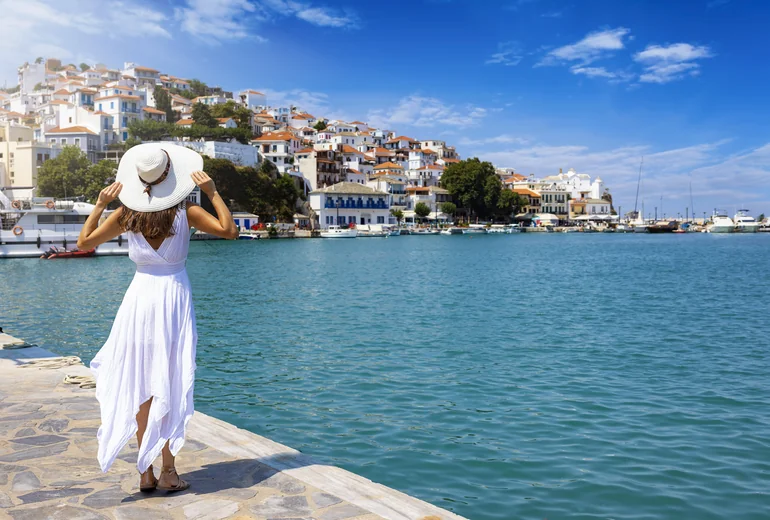
The Sporades chain — Skiathos, Skopelos, Alonissos — sits in a Meltemi-light corner of the Aegean. From Athens this means a long northbound transit or a re-pickup at Skiathos. Suits 10-day+ charters or operators able to shift the base.
Rare in practice and requires charter-operator agreement (one-way charter from Athens to Lefkada, say). The Corinth Canal transit is a 6-km cut between the Saronic and Corinthian Gulfs — itself worth doing — and the Ionian on the other side is essentially Meltemi-free. Logistics-heavy; suits experienced charterers who book the option in advance.
Five things to think about before signing:
1. Be flexible on destination, not just dates. If your priority is “Cyclades or nothing,” book either June or September (lower Meltemi probability) or accept that July-August is a lottery. Mid-July to mid-August carries the highest Meltemi-block probability in the year — we estimate a 30-40% chance any given week of the high season will see at least one Meltemi-driven route change for Cyclades-bound charterers from Athens or Lavrion.
2. Choose your starting base carefully. Lavrion and Athens carry the highest Cyclades route exposure. Lefkas in the Ionian is essentially Meltemi-free — if Cyclades exposure makes you nervous, the Ionian is the answer. Kos and Rhodes (Dodecanese) sit in a moderately-windy zone — less brutal than central Cyclades, more challenging than the Ionian. See our Rhodes / Dodecanese guide for that specific cruising ground.
3. Time of year matters more than people realise. June and September are the smart-money Cyclades months — warm water, lower Meltemi probability, charter rates 20-25% below peak. July-August is hottest, busiest, and highest weather-block risk for the open routes.
4. Skippered vs bareboat under weather risk. If your forecast window looks marginal, a skipper is the smart pick regardless of license status. A professional skipper has been through the same channel 50+ times, knows the alternative refuges, and has the authority to make the route call without crew-vs-crew debate. See our Below Deck reality check piece for context on how skippered weeks actually run.
5. Have a Plan B route in mind before you arrive. Your charter advisor at the booking stage should walk you through the most likely weather-block scenarios for your week and the corresponding alternative routes. If they don’t, ask.
A simplified walk-through of the decision:
Forecast review: meltemi.gr (aggregated Greek wind forecast), Poseidon (Greek national oceanographic service), ECMWF and GFS model runs, plus the local harbour-master’s marine port forecast. Evening-before brief covers 24-48 hours per candidate leg.
Exposure: which crossings are open-water vs sheltered, predicted wind angle (beam, headed, downwind), predicted sea state at critical hours, refuge within 2-3 hours of every point on the leg.
Refuge spacing: central Cyclades refuges are 4-8 hours apart in a Meltemi. Each leg needs a fallback harbour within reach if the forecast deteriorates mid-passage.
Daylight: Greek charters run dawn-to-dusk by convention. Land before 18:00 in shoulder months, before 19:30 in mid-summer. Open-water Cyclades crossings under Meltemi don’t tolerate end-of-day fatigue.
Insurance and contract: the operator’s policy and the charter contract both require the skipper to act on the forecast. “But we paid for the Cyclades” doesn’t override this — the contract excludes destination guarantees against weather.
Four things we do as standard:
Pre-charter brief includes Plan B. At the contract stage we identify the 2-3 most likely weather scenarios for your charter window and walk through the corresponding alternative routes. You arrive knowing what could shift, not learning it on day 2.
Skipper communicates forecast 24-48 hours ahead. If the route needs to change, you find out the evening before, with the model runs on the table and the alternative drawn on the chartplotter.
Alternative routes offered before disappointment sets in. The Saronic, the Argolic, the Sporades and the Ionian are all flagged in your pre-charter brief as Plan B options. The skipper isn’t proposing a downgrade — they’re proposing the safe-week version of the trip you came for.
Rebooking conversations. For genuinely weather-shortened trips, we work with you on rebooking. Specific terms vary by case and operator; discuss with your charter advisor at the point you’d want to consider this.
— Greek Islands by Catamaran — Cyclades, Ionian and Saronic compared
— Sailing from Rhodes — Dodecanese itinerary and anchorages
— Paros by Catamaran — must-see anchorages
— Greek catamaran provisioning 2026 cost guide
— Below Deck in Greece — the reality check
— Catamaran Charter Greece home
Browse the 2026 fleet on the Catamaran Charter Greece fleet page. For a custom quote that includes a Plan B route brief at the contract stage, use the contact form on the site and we’ll come back within 24 hours.
No. The charter agreement and Greek maritime safety law both give the skipper final authority over the route. This is standard ship-master responsibility — it isn’t a negotiable clause. The right time to influence the route is at the contract stage, when you and your advisor discuss the Plan B options, not on day 2 in 30-knot wind.
Generally no — weather-driven route changes are treated as force majeure by every Greek charter operator we know. The alternative is a smarter itinerary along sheltered routes rather than a refund. For genuinely weather-shortened weeks (return-early, cancelled-day scenarios), we work with you on rebooking; specific terms vary by case. Discuss with your charter advisor before booking.
Counter-intuitively, no. As a bareboat skipper you have the same forecast information a professional skipper has but typically less local knowledge of the Greek refuges, the harbour-master rules, and the navigational quirks of the chain you’re sailing. There’s no override authority above you, which means a bad call by the bareboat skipper is the call. Under marginal Meltemi forecasts the professional-skipper option is a meaningful safety upgrade, not a downgrade.
Lefkas in the Ionian is essentially Meltemi-free and the lowest-weather-risk Greek base. Athens and Lavrion carry the highest Cyclades-route exposure but also the best access to the alternative Saronic and Argolic loops. Kos and Rhodes (Dodecanese) sit in a moderately-windy zone — less brutal than the central Cyclades but not Ionian-light. Match the base to the route you actually want to sail.
June and September are the sweet spots. The Meltemi is present but typically runs at lower force (20-25 knots vs 30-35 in peak) and shorter duration (1-2 days vs 3-5 days). Charter rates in those months also run 20-25% below peak July-August. If the Cyclades are your priority, those are the weeks to book.