

Syros & Astypalaia: Next-Wave Greek Islands to Charter Before the Crowds (2027)
Why Syros and Astypalaia are the Aegean islands to book first for 2027, and how each fits a Cyclades or one-way charter route.
Read more

Getting from the United States onto a Greek catamaran is simpler than most Americans expect. Several US hubs typically run nonstop flights to Athens in summer, and the two main mainland charter bases sit roughly 30 to 45 minutes from the arrivals hall. That puts a catamaran charter Greece from the USA trip inside an ordinary American vacation: one overnight flight out, two nights in Athens, seven nights aboard.
What follows is the version of our advice written for US crews. It covers which nonstops to check for summer 2027, whether to start at Alimos or Lavrion, which Greek sea fits a single week, the paperwork Greek port police ask for when your skipper trained on an ASA or US Sailing course, and what the whole thing costs in dollars.
Athens is the one Greek airport with a real network of transatlantic nonstops. In recent summers that has typically meant United from Newark, Delta from JFK, Atlanta and Boston, American from JFK, Philadelphia and Chicago, and Emirates on its JFK to Athens service. The newest addition is American’s daily Dallas/Fort Worth to Athens, which started on 21 May 2026 on a Boeing 787-8 and gives Texas and much of the South a route without a European connection. Airlines publish their 2027 schedules route by route, so treat this list as the place to start rather than a promise, and check the carrier sites before you fix the charter week.
From the East Coast the flight is an overnight crossing, typically in the region of nine to ten hours. West Coast crews usually connect, either through one of those East Coast hubs or through a European hub such as Frankfurt, Munich, Zurich or Amsterdam. The clock is the real adjustment: in summer Greece runs seven hours ahead of New York and ten ahead of Los Angeles, so most Americans land in the morning feeling like it is the middle of the night.
Some US crews are weighing Greece against the Adriatic, where United has flown nonstop from Newark to Dubrovnik and Split. If that is your shortlist, our sister site’s Croatia guide for American sailors covers those flights and the US certificates Croatia lists officially.
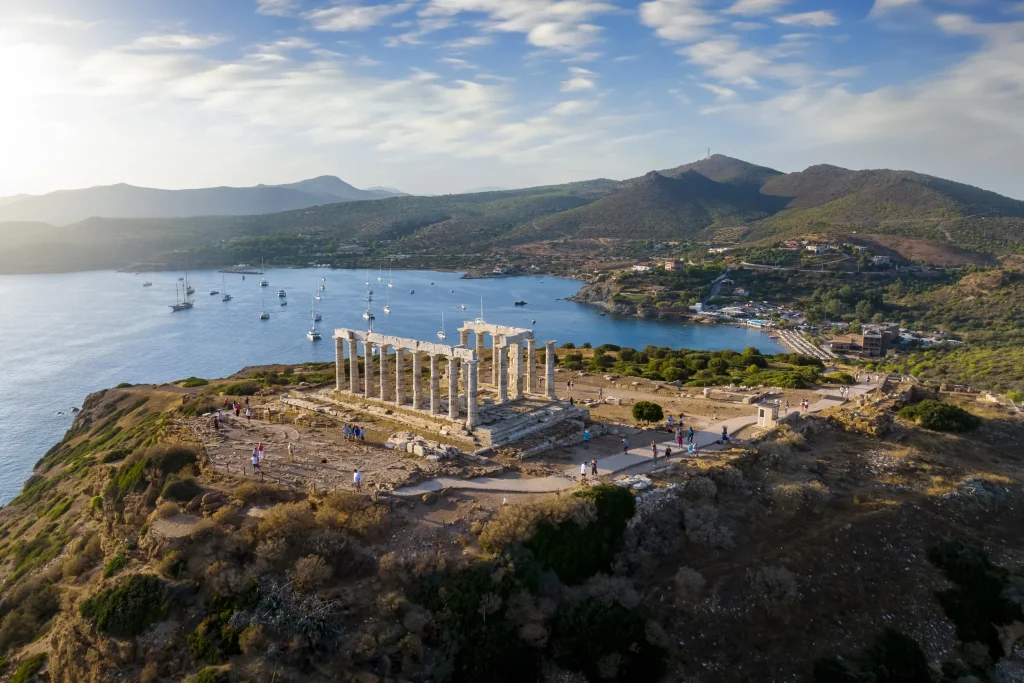
Most mainland catamarans leave from one of two marinas. Alimos, on the Athens Riviera south of the city centre, is the larger one and the natural start for the Saronic Gulf; Aegina is a morning’s sail away. Lavrion sits on the other side of Attica, close to Cape Sounion, and is usually the quicker taxi from the airport. It is also the better start for the Cyclades, since Kea is only a couple of hours’ sailing east.
In practice, the choice follows the sea you want rather than the other way round. A crew heading for Hydra and Spetses saves half a day by starting at Alimos; a crew aiming for Kythnos, Serifos and Sifnos does the same from Lavrion. Both have supermarkets within walking distance, and both get busy between 15:00 and 19:00 on a Saturday, when the whole fleet changes over. Our guide to Greek charter marinas has the berthing and parking detail for each.
Greek charters typically begin on Saturday afternoon, with boarding from around 17:00, and end with the boat back on the dock by 09:00 the following Saturday. That fixed rhythm is the reason we suggest most American crews fly out on a Wednesday evening. You land in Athens on Thursday, sleep, spend Friday on the city and board on Saturday with the jet lag mostly gone.
Friday is enough for the essentials if you start early. Walk up to the Acropolis at opening time, before the tour groups and the heat, then spend the late morning in the Acropolis Museum, where the air conditioning is part of the appeal in July. Lunch in Plaka or Koukaki, a nap, and dinner at a taverna serving grilled octopus, fava and a cold Assyrtiko. On Saturday morning a crew member can do the big supermarket run while the others take a taxi to the marina with the bags.
The return leg works the same way in reverse. Check-out is early, and several US-bound flights leave Athens around midday, so a same-day departure is possible; a Saturday night in the city and a Sunday flight is calmer. Counting both weekends, the whole trip uses about seven vacation days, which is what makes Greece realistic for American schedules.
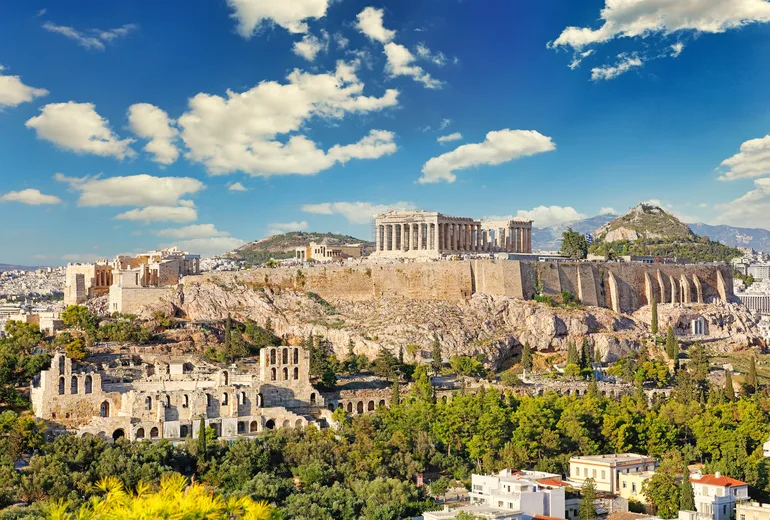
Greece has three main sailing areas within reach of a one-week charter, and they differ more in wind than in scenery. For a US crew with seven nights and a fixed flight home, the wind is the deciding factor.
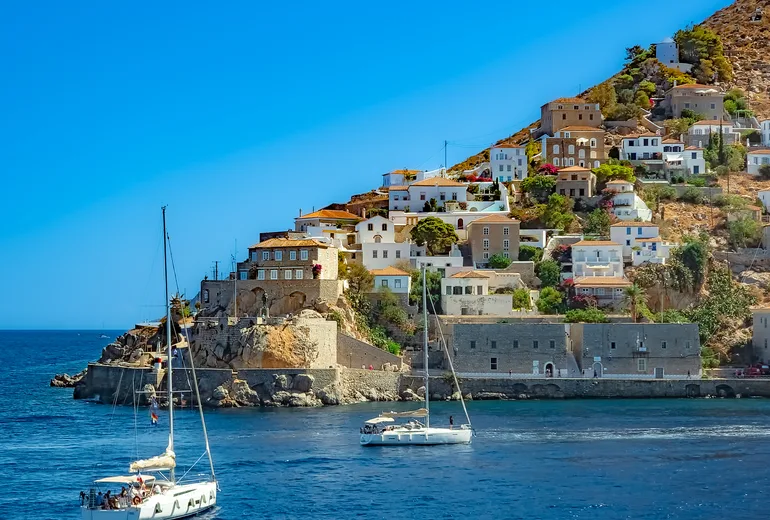
Aegina, Poros, Hydra and Spetses sit in sheltered water south of Athens, with hops of 10 to 20 nautical miles and an afternoon breeze that is usually manageable. It suits a first Mediterranean charter, a crew with young children or anyone who wants long lunches ashore more than long passages. Hydra has no cars, and its tiny harbour gets crowded, so many crews anchor nearby and take the dinghy in.
Kea, Kythnos, Syros, Paros and Milos are the islands on the brochures, and they are a step up. In July and August the meltemi, a dry northerly, can blow 20 to 35 knots for several days at a time. A catamaran copes, but legs between islands are longer and exposed, and plans change. For a single US vacation week, June or September is the safer Cyclades window. Our honest take on whether the Cyclades are too windy in August goes into the forecasts.
The Ionian, on the west coast around Lefkada, Kefalonia and Corfu, has the gentlest summer wind of the three. The catch for Americans is the extra leg: there is no nonstop from the US, so you add a domestic flight from Athens to Preveza, Corfu or Kefalonia. With seven nights aboard it works well; with a tighter vacation, the Saronic or Cyclades from Athens wastes less time. There is a side-by-side breakdown in our Cyclades, Ionian and Saronic comparison.
Greece regulates bareboat charter more tightly on paper than many US sailors expect. Before a bareboat leaves the base, the skipper must show a recognised sailing certificate, and a second crew member has to either hold one too or sign a declaration of competence. The charter base checks the documents and the crew list, and the local port police can ask to see them.
For American skippers the sticking point is which certificate counts. ASA 104 Bareboat Cruising and the US Sailing bareboat certification are accepted by most charter companies in Greece. However, some sources report that port police no longer accept non-European certificates on their own, and that is not a conversation you want on a Saturday evening. The simple fix is to carry an internationally recognised document as well: the International Proficiency Certificate issued through ASA or US Sailing, or an ICC. A state boater-education card is not a sailing certificate in this sense, and a USCG captain’s licence is a commercial credential that some operators will consider alongside a sailing résumé and some will not.
The safe sequence is to send us copies of the skipper’s and co-skipper’s documents before you pay a deposit; we confirm with the operator in writing. If there is any doubt, a hired skipper solves it, at roughly €1,400 to €1,750 per week plus food. The full rules are in our post on boat licence rules for renting in Greece.
Prices on this site are set in euro, and the euro figure is the contract price; the dollar amount you see is a conversion. We use roughly US$1.15 to US$1.20 to the euro below, and rates move, so the dollar side will shift a little between quote and balance payment.
Split between eight friends, a June week on a 42-footer with running costs comes in around US$1,000 to US$1,300 each before flights. Greek town quays are often cheap or free outside the big marinas, which keeps the extras down.
Tipping is the other thing Americans ask about. In tavernas, rounding up or leaving 5 to 10 percent is typical and appreciated, not the 20 percent you would leave at home. For a hired skipper, a tip at the end of the week is customary, usually somewhere between 5 and 15 percent of the skipper fee depending on how the week went. Cards work in most towns, but small island tavernas and water taxis often want cash.
US citizens do not need a visa for Greece. A stay of up to 90 days in any 180-day period across the whole Schengen area is allowed, so a two-week trip that also takes in Italy or Croatia is nowhere near the limit. Your passport should have been issued within the last ten years and be valid for at least three months beyond the date you leave the Schengen area; many advisers suggest six to be safe.
The new piece is the EU Entry/Exit System, fully running across Schengen since April 2026. On your first entry you give fingerprints and a facial image at the border instead of getting a passport stamp, and the first registration can mean a longer queue. If you have a connecting domestic flight to Preveza or Corfu, leave a generous margin.
The EU’s online travel authorisation, ETIAS, is not required yet and has no confirmed start date; it is expected in 2027 at the earliest. Check the EU’s official travel site before you fly. Note that ESTA is the American system for visitors to the US and has nothing to do with entering Greece.
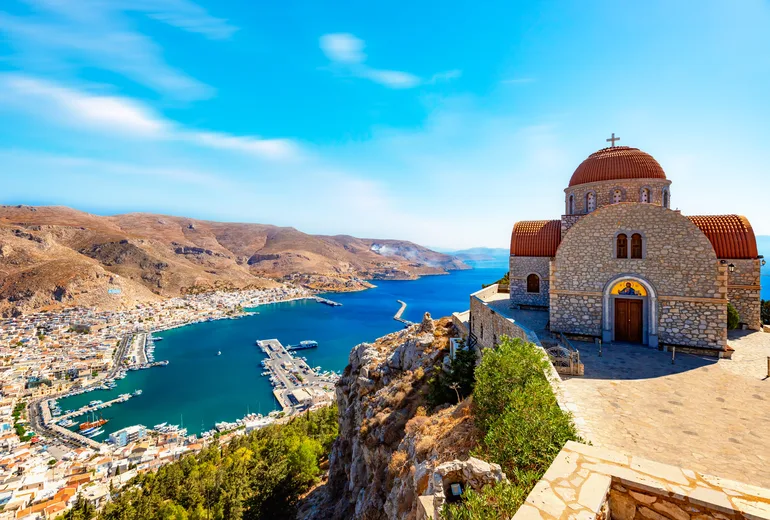
A fair number of our American enquiries start with a grandparent’s island. Greek-American families trace their roots across the whole map, from Crete and Chios to Ikaria and the Dodecanese, and a catamaran is often the most practical way to reach a small home island without juggling ferry timetables. Kalymnos is a good example: its sponge-diving families are behind the Greek community in Tarpon Springs, Florida, and the island sits within a day’s sail of Kos.
If the family island is in the Dodecanese, a one-week charter from Rhodes or Kos usually makes more sense than starting in Athens. Our Rhodes catamaran itinerary shows how the distances work. Tell us the village and the dates, and we will suggest a base and a route that gets you there on a calm day.
Yes, to Athens. Several US hubs typically have summer nonstops, including Newark, JFK, Atlanta, Boston, Philadelphia, Chicago and, since May 2026, Dallas/Fort Worth. The 2027 schedules are published airline by airline, so check before you book the boat.
Most charter companies accept ASA 104 or the US Sailing bareboat certification, but some sources say port police may not accept non-European certificates alone. Carry the ASA or US Sailing International Proficiency Certificate or an ICC as well, and make sure a second crew member can sign the competence declaration.
The Saronic Gulf from Alimos is the easiest, with short hops and shelter close to Athens. The Cyclades from Lavrion suit experienced crews best in June or September, when the meltemi is usually weaker. The Ionian has the gentlest wind but needs an extra domestic flight.
A 40 to 42-foot bareboat catamaran costs about US$3,600 to US$9,000 per week in the shoulder season and roughly US$6,900 to US$14,200 in July and August, at US$1.15 to US$1.20 per euro. Add running costs of about US$1,400 to US$2,400 per week for eight.
Not as of November 2026: ETIAS is not in force and no start date has been confirmed. It is expected in 2027 at the earliest, so check the official EU site shortly before you travel.
Once you have a week in mind, compare Greek bases and sailing areas and send us your dates and the skipper’s certificates; we will come back with available catamarans and a clear answer on the paperwork.
Your privacy
You can read more about how we protect your personal data and use cookies in our Privacy Policy.
With your consent, we and Google use cookies and similar technologies to store and access information on your device and to process personal data such as your visit to this website, your IP address and cookie identifiers. You can withdraw your consent at any time through “Cookies Settings” at the bottom of every page.
We and Google process data for:
Website analytics and visit statistics, recordings of visits to improve the website, ad measurement and remarketing, storing and accessing information on your device